Peptides · Repair & recovery
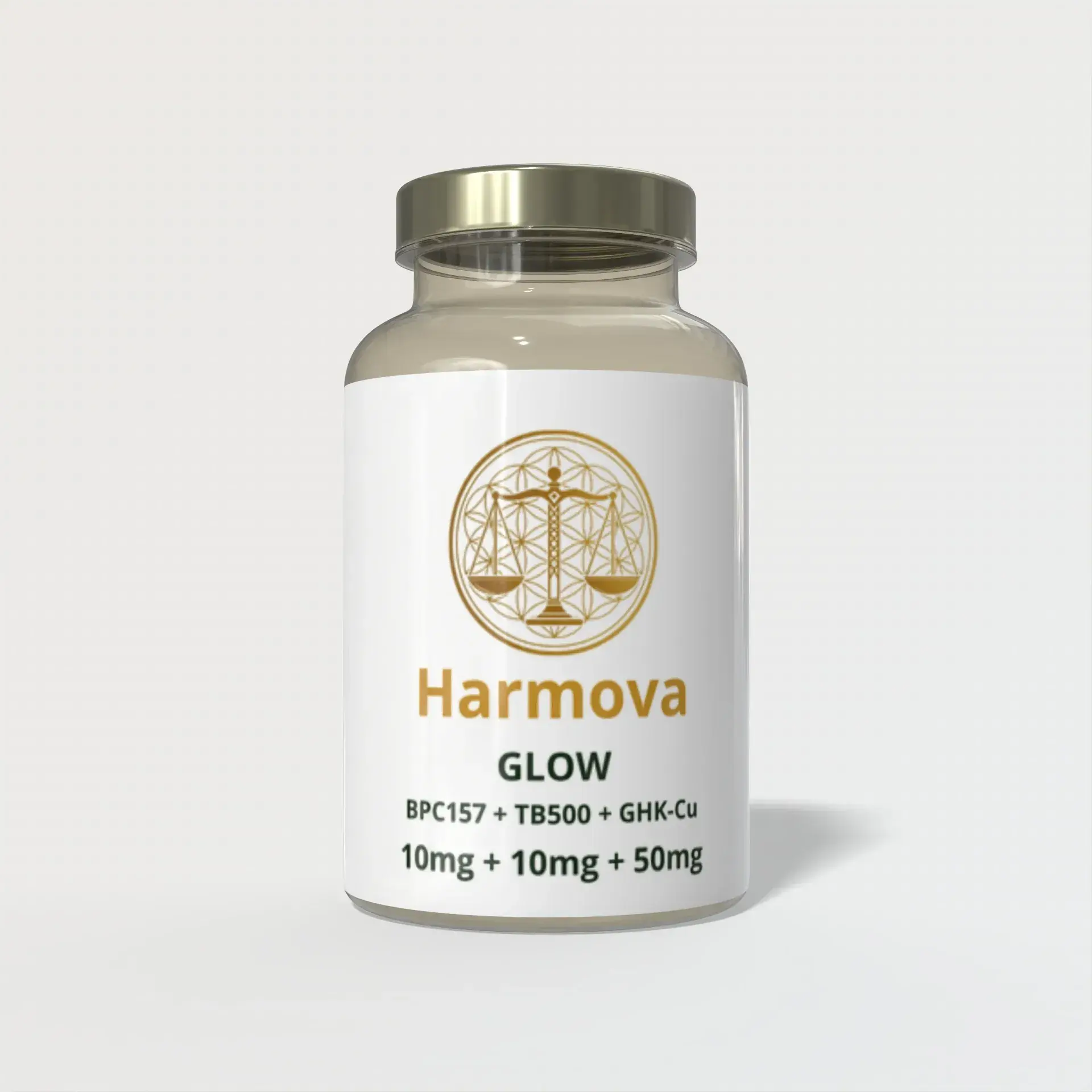
For research use onlyGLOW — BPC157 + TB500 + GHK-Cu 10mg + 10mg + 50mg (Canada)
Triple peptide blend for research contexts: BPC-157 10mg, TB-500 10mg, and GHK-Cu 50mg per vial. Often discussed around tissue repair, inflammatory balance, and skin-matrix support. Syringes included. Canada only.
Not sure where to start?
Book a wellness consult to talk through protocols, dosing questions, or whether this product fits your goals.
Book a consult →Disclaimer: Photos are representative. Packaging, labeling, or physical appearance may differ slightly from what you see here, but the item we ship matches the description and specifications on this page.
Key points
- Syringes included
- Three-peptide stack oriented to repair, recovery, and matrix support
- Often discussed for inflammatory balance and healing timelines
- Skin and connective-tissue rejuvenation themes (GHK-Cu + partners)
- Joint, fascia, and mobility conversations tied to TB-500–class research
- Gut mucosal repair sometimes explored with BPC-157 in preclinical models
- Collagen / elastin pathways highlighted across components
How to use
Injectable; use only under a licensed prescriber or qualified professional. Reconstitution volume, injection depth, and exact microgram targets must follow your clinician and the product label—potencies differ from lower-strength blends, so do not copy protocols meant for other ratios. Many published discussion frameworks mention weekday-only schedules, defined active windows on the order of several weeks, and mandatory off-periods before any repeat cycle; confirm every detail with your provider.
Ingredients & specs
- Size
- 10mg + 10mg + 50mg
- Ships to
- Canada
- Category
- Peptides · Repair & recovery
Ingredients
Batch docs: Request a certificate of analysis (CoA) or batch details from sales@harmova.health. We'll point you to the right documentation for this SKU.
How it works
A closer look at this protocol
Deep dive
GLOW — BPC157 + TB500 + GHK-Cu 10mg + 10mg + 50mg (Canada)
Research-use injectable (not for cosmetic or at-home use unless expressly permitted where you practice).
What it is
GLOW combines three well-studied peptides in one vial. The idea is complementary biology: each compound leans on different cell signals—nitric oxide and vessel-related pathways, structural protein dynamics, matrix turnover, and how cells handle oxidative stress—so together they may support a wider repair picture than any single ingredient alone.
Why combine them?
BPC-157, TB-500, and GHK-Cu overlap in “repair” conversations but hit different molecular levers. In research models they are discussed alongside inflammation control, new vessel formation, fibroblast behavior, and stress-response genes. That parallel activity is why formulators sometimes pair them for coordinated recovery-oriented protocols.
Ingredient snapshot (this SKU)
• BPC-157 — 10mg per vial • TB-500 (thymosin beta-4 analogue space) — 10mg per vial • GHK-Cu (copper-associated tripeptide) — 50mg per vial
Themes in the literature (education only)
Not a promise of results for any individual.
• Tissue and matrix support after strain, surgery, or overuse • Calming excess inflammatory signaling in preclinical work • Skin firmness, elasticity, and collagen-related conversations (especially around GHK-Cu) • Connective tissue mobility and fascial stiffness discussed with TB-500–class compounds • Gut-barrier and mucosal repair sometimes linked to BPC-157 in animal models • Collagen and elastin pathways explored across BPC-157 and GHK-Cu • Hair follicle biology occasionally studied with GHK-Cu alongside other modalities
Mechanistic highlights (high level)
Vessels and angiogenesis
BPC-157 is often described in relation to VEGFR2-related signaling without simply dumping more VEGF. GHK-Cu papers mention growth-factor expression in stressed fibroblasts. TB-500–class peptides are discussed as chemoattractants for endothelial cells.
Repair and cell movement
TB-500 is tied to actin handling and cell movement. GHK-Cu is associated with broad gene-expression shifts toward repair. BPC-157 is linked to focal-adhesion signaling in regeneration stories.
Matrix and collagen
GHK-Cu at trace concentrations appears in collagen and glycosaminoglycan discussions. BPC-157 shows up in collagen and vessel-density readouts in animal injury models. TB-500 is described as encouraging orderly collagen rather than dense scar in some wound papers.
Inflammation
GHK-Cu is discussed with NF-κB and MAPK pathways. BPC-157 appears in cytokine and COX-2 conversations. TB-500 is framed as helping re-balance pro- and anti-inflammatory messengers.
Oxidative stress
All three are mentioned alongside ROS control and antioxidant enzyme support in cell and animal work.
Neural research (early-stage)
GHK-Cu in neurotrophic-factor contexts; BPC-157 in transmitter-system modulation; TB-500 in apoptosis and glial-lineage studies—still exploratory and not a basis for clinical claims.
Important
This is not medical advice. It does not diagnose, treat, cure, or prevent disease. For qualified research or prescribing contexts only.
THIS PRODUCT ONLY SHIPS WITHIN CANADA.
Social proof
What customers are saying
“Blend arrived cold-packed and exactly as described. My practitioner handled the protocol — experience has been smooth.”
GLOW blend · March 2026
“Skin tone looks more even after a full cycle. Blend is convenient — one reconstitution instead of juggling three vials. Reordering.”
GLOW blend · February 2026
Regional honesty
Every SKU states where it ships before you add to cart.
Readable listings
Ingredients, size, and kit contents are spelled out on the page — not hidden in PDFs.